

As tensions with Iran escalate, Donald Trump confronts a paradox of power: a conflict intended to project strength is instead exposing institutional constraints, eroding political capital, and increasing the likelihood of more erratic and escalatory decision-making at the top of the U.S. executive.
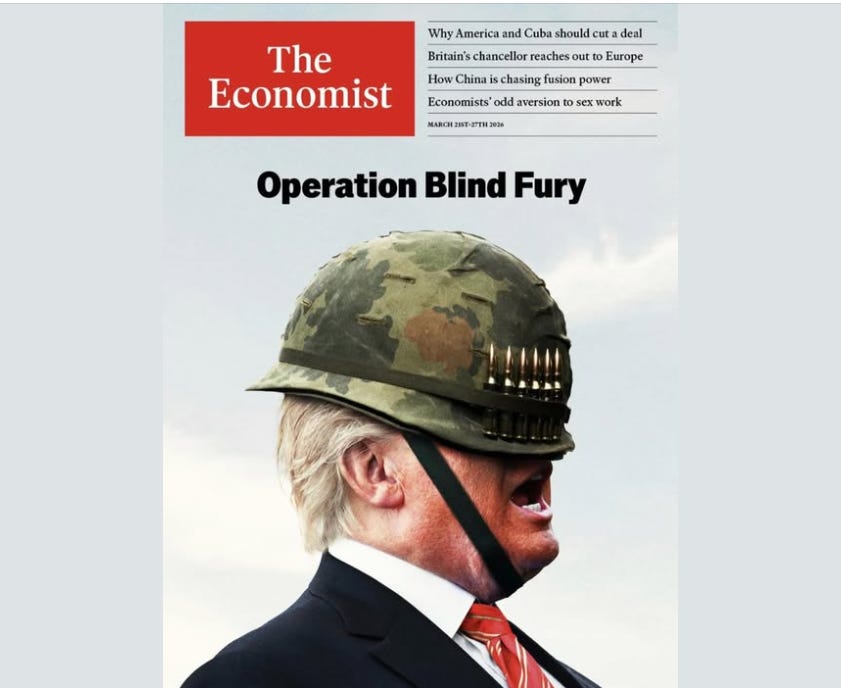
The cover of The Economist (21 March 2026) portrays Donald Trump wearing a combat helmet studded with bullets, a visual metaphor for a presidency increasingly defined by militarised decision-making and mounting political vulnerability. The accompanying article, “Operation Blind Fury”, advances a dual argument: that the administration’s approach to Iran is simultaneously eroding the structural foundations of presidential power while heightening the risks associated with an increasingly unconstrained executive, and eroding the American democratic foundations.
At the core of the analysis lies the paradox of executive authority in wartime. Historically, U.S. presidents have derived significant political capital from external conflicts, often consolidating domestic support through the so-called “rally-around-the-flag” effect. However, the emerging confrontation with Iran appears to deviate from this pattern. Rather than strengthening Trump’s position, the conflict exposes institutional limits and political fragmentation within Washington, and lack of popular support as never seen before. The United States Senate’s rejection of a war powers resolution signals not unity but division, reflecting broader unease regarding both the strategic rationale and the legal basis of military escalation. However, the Israeli lobbies have played an important role in the decision.
Simultaneously, the Pentagon’s request for additional congressional funding signals the material and temporal scale of the conflict. A prolonged military engagement—extending over months rather than weeks would not only strain U.S. resources but also intensify scrutiny from political opponents and the public. In this sense, the Iranian theatre works less as a site of decisive victory and more as a protracted test of governance capacity, where ambiguity and attrition replace clarity and control.
Crucially, The Economist’s article points that the erosion of Trump’s “political superpowers”—his capacity to dominate media narratives, mobilise his electoral base, and circumvent institutional constraints—may produce unintended consequences. As these mechanisms weaken, the president may become more prone to risk-taking behaviour, relying increasingly on coercive or unilateral instruments to reassert authority and his authoritarian trait. This dynamic aligns with broader theories in political science that link declining domestic legitimacy with escalatory foreign policy choices.
The strategic ambiguity surrounding U.S. objectives further compounds the problem. Without a clearly articulated end-aim, military operations risk becoming self-perpetuating, driven by short-term tactical considerations rather than coherent grand strategy. This not only complicates alliance coordination—particularly with Israel—but also heightens the probability of miscalculation in an already volatile regional environment.
Lastly, the article frames the situation as a critical juncture in U.S. foreign policy. The convergence of institutional resistance, fiscal constraints, strategic uncertainty, and authoritarian traits places the Trump administration in a precarious position. A drawn-out conflict with Iran could accelerate political decline, yet the very pressures generated by this decline may incentivise further escalation.
My final take: weakness does not necessarily produce restraint; rather, it may generate a more unpredictable and potentially dangerous exercise of power - especially when Donal J. Trump is the president of the United States.
Here is how to connect to my/our Mastering Geopolitics community:
Substack:
My new e-book: Understanding Intelligence in Global Affairs: An Introduction - Geopolitical, diplomatic, international relations, economic, territorial & social intelligence: -https://www.lulu.com/spotlight/intelligenceinglobalaffairs
X: @JosRica47689245
BlueSky: @jrm3.bsky.social

Support this work
If you value independent analysis on geopolitics, international relations, and global affairs, consider supporting this publication. Your contribution helps keep this Substack open and accessible to everyone.
Support options:
PayPal: @jricardomartins
Buy me a coffee: https://ko-fi.com/jricardomartins
Buy my e-book “Intelligence in Global Affairs: An Introduction”:
https://www.lulu.com/spotlight/intelligenceinglobalaffairs